Passive haptics based mixed reality system
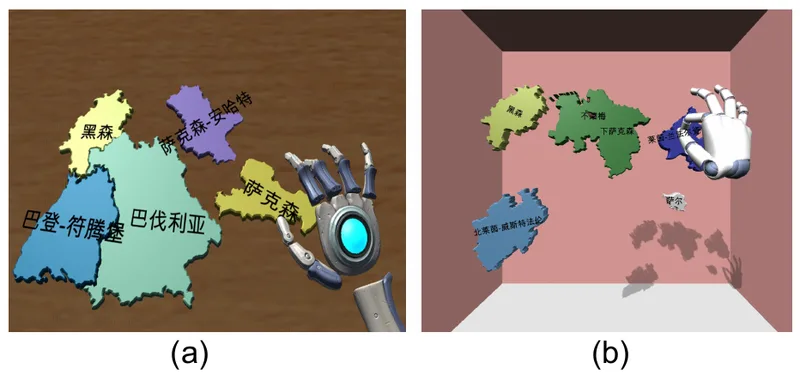
Most virtual reality systems convey touch poorly: controllers vibrate, and force-feedback devices tie the user to a stylus inside a small workspace. Passive haptics takes a cheaper route, using ordinary physical objects as stand-ins that the user touches while the headset shows a virtual counterpart, so the virtual hands and objects must line up closely with the real ones.
The ISMAR paper builds such a system, in which users handle real objects with bare hands at close range, proposes a calibration method for head and hand tracking, and measures the accuracy of each. The VRCAI paper applies it to geography teaching, with laser-cut acrylic puzzle pieces tracked by markers, and compares learning with passive haptics, with free-hand gestures in VR and with a real puzzle. A later room-scale version tracked the objects and the user’s head with PhaseSpace optical tracking and the arms and hands with Perception Neuron sensors.
Main results
- In a study with 18 participants learning the German states through a map puzzle, quiz accuracy was highest with passive haptics (mean 95%), against 84% both for a real puzzle and for free-hand gestures in VR.
- Completing the puzzle took longest with passive haptics (mean 769.4 s, against 465.3 s for the real puzzle and 350.3 s for free-hand gestures), mainly because of the camera's narrow field of view and hands hiding the markers.
- Asked which virtual setup they would choose for learning if tracking were reliable, 15 of the 18 participants chose passive haptics.